
Endogenius Intelligence from within

Technology

Built for decisions — not for chat.

Endogenius™ licenses a patent-pending decision engine and domain suites to partners who keep the client. Two named pieces do the work: F(T) ranks what to do next when conditions keep changing; BDN slows or blocks action when trust is too low. Open Solutions for each product window. The motto is spelled out in Intelligence from within.

How we think

Intelligence from within.

Endogenius builds intelligence from accumulated experience, not from a single prediction or a fixed rulebook.

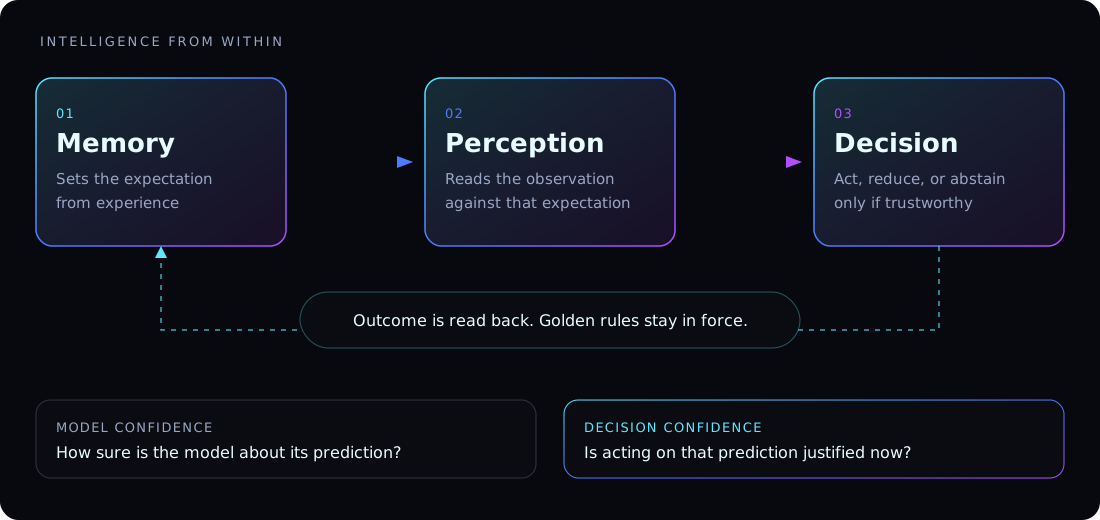
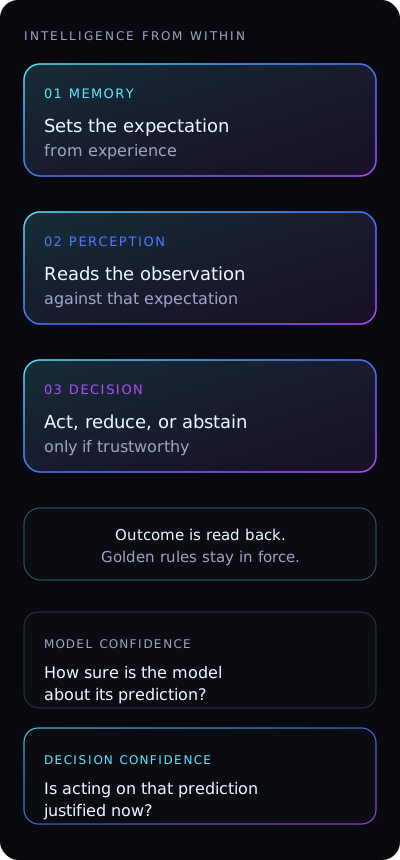
Diagram: memory sets an expectation, perception compares the new observation, and the decision acts, reduces, or abstains only when it is trustworthy. The outcome is read back and the golden rules stay in force. Diagram: memory sets an expectation, perception compares the new observation, and the decision acts, reduces, or abstains only when it is trustworthy. The outcome is read back and the golden rules stay in force.

Memory → Perception → Decision

Accumulated memory sets what the system expects.

A new observation is read against that expectation. Patterns are identified and weighted according to the conditions now. An action is taken only when it is permitted — and when the decision itself is trustworthy enough to act on.

Prediction is not decision

Model confidence asks: How sure is the model about its prediction?

Decision confidence asks: Is acting on that prediction justified now?

A model can be highly confident and the action can still be reduced or refused.

Learn without losing control

The outcome is read back.

An unfixed weight may move. The system can adapt to what happened without rewriting the rules that must remain in force.

Golden rules stay authoritative.

One intelligence spine. Different worlds.

The same principle applies across the domains where Endogenius operates.

Intelligence from within means that the system does not simply ask “What does my model predict?”

It asks: “Given what I have experienced, what I see now, and what I am allowed to do — is this decision trustworthy enough to act?”

Why we are different

Not another generative AI — real-world AI.

Generative AI drafts and summarises. Deep learning spots patterns in stable data. Both struggle when today’s “normal” is not yesterday’s — and a fluent answer is not a safe decision.

We build real-world AI for what to do next under uncertainty — not another chatbot: sensing when confidence should drop, respecting domain rules, gating action when evidence conflicts, and keeping a trail you can review.

  • Designed for changing conditions, not only fixed benchmarks
  • Cautious when unsure — not confidently wrong
  • Explainable enough for partners and operators to defend

10-second LinkedIn explainer — vs LLM / ML stacks.

Patent-pending stack

F(T) ranks. BDN gates.

Same pair in every domain — healthcare, fintech, cybersecurity, defense. Different clocks (seconds vs weeks), same logic. EIC reviewers will also see this called Perception–Action–Control or A→B under M — those are names for this loop, not a second platform.

  • F(T) Ranks what next

    Fuses signals when the world will not sit still — markets and cyber by the second; patients and missions by the case and by the week — and ranks what to do next, with a trail you can review.

    In short: belief and priority update as new facts arrive, instead of freezing on yesterday’s “normal.”

  • BDN Gates when unsure

    Asks whether trust is high enough to act on that ranking. When evidence is thin, conflicting, or out of distribution, BDN slows the path — flag, monitor, or ask for more data — instead of a confident wrong move.

    In short: F(T) proposes; BDN decides if the proposal is safe enough to lean on.

Partners keep the client and the final call. We supply the ranked options and the trust gate — not a black-box prescription or auto-block.

Four domains

Where this goes to work.

Same F(T) + BDN stack. Separate product suites and evidence for each field — open a Solutions window for detail.